I just had an incredible conversation with my colleague, Christine Levy—founder of Levy Educational Advocacy, parent, and someone who brings a really thoughtful lens to how we understand and support kids with learning differences.
We initially set out to talk about her work in advocacy and school-based accommodations.
But like many meaningful conversations do… it expanded.
We found ourselves asking a bigger question:
What does it actually look like to support the whole child—across all the environments they move in?
Because as Christine named so clearly, learning differences don’t stay contained to the classroom.
They show up on the field…
On the court…
In the gym…
Sports is chock-full of fast, high-pressure moments where processing, memory, and confidence are all being asked to work.
The Brain Doesn’t Separate Environments
I’ve been brewing over what Christine said:
“We’ve built systems in education to support how kids learn—but we forget they take that same brain everywhere else.”
A child with dyslexia, ADHD, or executive functioning challenges doesn’t suddenly process information faster during a fast break.
They don’t retain multi-step directions more easily just because they’re wearing a jersey instead of sitting at a desk.
And yet… sports environments often expect exactly that.
When Effort Gets Misread
Christine spoke to something I’ve witnessed in my own work with young athletes, too.
Young people who are:
- Labeled as “not paying attention”
- Seen as “unmotivated”
- Benched because they “don’t get it” quickly enough
When underneath that, what might actually be happening is:
- Working memory is overloaded
- Directions are coming too fast or in too many steps
- Language is being processed more slowly
- There’s internal anxiety about getting it wrong
The gap isn’t effort. It’s access.
Accommodations Belong on the Field, Too
In school settings, we’ve made space for things like:
- Breaking information down
- Visual supports
- Repetition and rephrasing
- Scaffolded learning
And Christine gently—but clearly—challenged coaches, parents, and guardians this:
“Why would those supports disappear in sports?“
What might shift if coaches:
- Broke plays into smaller pieces
- Modeled visually or physically
- Checked for understanding instead of assuming it
- Allowed repetition without attaching judgment
- Gave cues in more than one way
This isn’t about changing the game. It’s about changing access to the game.
Parents as Insight, Not Interference
A theme Christine returned to again and again was the role of parents.
No one knows their kids more than their parents.
So when parents say things like:
- “My child does better with one direction at a time”
- “It helps if they can see it first”
- “If they look disengaged, they might actually be overwhelmed”
That’s not overstepping. That’s information.
And yet, in sports environments, parents can feel hesitant to speak up—worried about being labeled as “difficult” or “too involved.”
Christine said it simply:
“We have to move from judgment to partnership.”
Coaches Are Teachers (Whether They Realize It or Not)
If there was one idea that anchored our conversation, it was this:
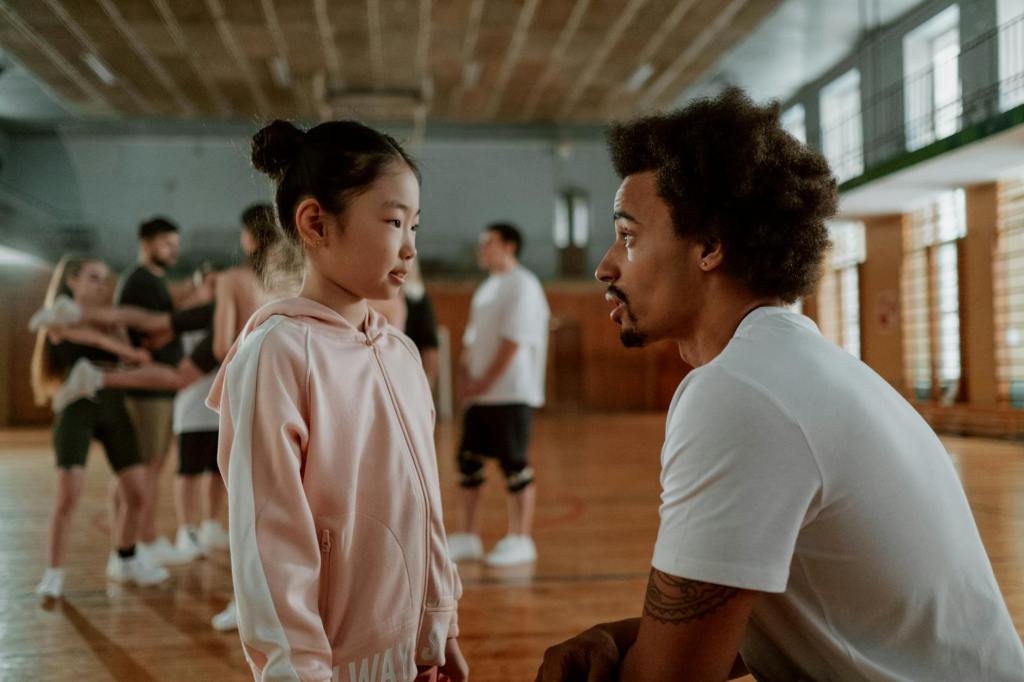
Coaches are educators.
And the great educators understand:
- Not every learner learns the same way
- Behavior is often communication
- Clarity takes intention
- Connection drives performance
Christine emphasized that small shifts can make a profound difference:
- Slowing down instructions
- Asking one more check-in question
- Demonstrating instead of repeating louder
- Creating psychological safety for mistakes
These are not time-consuming changes. But they can totally change a child’s entire experience.
The Confidence Piece
When athletes don’t understand what’s being asked of them, they don’t just struggle with performance. They struggle with identity.
They start to internalize:
- “I’m not good at this”
- “I don’t belong here”
- “I’m always behind”
But when the environment shifts—even slightly—so that instruction aligns with how they learn…
Something else becomes possible.
They engage.
They improve.
They start to trust themselves again.
A Shared Responsibility
What I appreciated about this conversation is that it wasn’t about placing blame.
It was about shared awareness. A community coming together.
- Parents bring insight
- Coaches bring opportunity
- Advocates help bridge understanding
And the child stands at the center of it all.
Learning More from Christine

If this conversation resonates, and you’re wanting more support in understanding or advocating for your child’s learning needs, Christine offers thoughtful, individualized guidance through her work at Levy Educational Advocacy.
You can learn more about her services and approach here:
https://www.levyadvocacy.com/
Final Thought
As I left our conversation, one idea stayed with me:
Supporting the whole child means showing up for how they learn. Everywhere they learn.
Not just in classrooms with formal plans and accommodations. But on fields, courts, sidelines, and beyond.
Because when we align those worlds, we don’t just create better athletes.
We create environments where every child has a real chance to succeed.
In solidarity,
Laura
Reflection Prompts
- Where might I be expecting a child to “perform differently” instead of recognizing how they actually process and learn?
- When I see a child struggling, do I first interpret it as effort—or do I get curious about what might be getting in the way?
- What is one small way I could adjust how I communicate or teach to make something more accessible—without changing the expectation itself?
- How do I currently respond to parent input—and what might shift if I approached it as collaboration rather than critique?
- Where might I be repeating instructions louder… instead of adjusting how I’m teaching?
- How might my environment be shaping how a child sees themselves—not just how they perform?
Disclaimer
This content is for educational purposes only and is not a substitute for mental health treatment or individualized professional support. If you or someone you know is in distress, please call or text 988 (U.S.) for immediate support. In an emergency, call 911.
 The Athlete Psychotherapist
Leave a comment