Why athletes and coaches can’t afford to ignore emotions
In competitive sports, the message is clear: push through. Push through fatigue, push through pain, push through doubt. Many athletes and coaches are conditioned to believe that feelings — especially the messy, uncomfortable ones — are distractions, weaknesses, or something best left in the locker room.
But here’s the truth: ignoring your emotions doesn’t make them disappear. It just makes them work harder in the background, influencing your decisions, your relationships, your coaching style, and even your performance without you realizing it. In sports psychology, this is where emotional awareness becomes a game-changer.
Feelings Are Not Fluff
Emotions are signals, like the dashboard lights in your car. They tell you something’s going on under the hood. Recognizing and naming them isn’t “soft” or “woo-woo.” It’s the foundation for mental toughness and sustainable athlete mental health.
When you can say, “I’m frustrated because my body isn’t recovering like it used to” or “I feel anxious about letting my team down,” you’re taking ownership. You’re bringing something hidden into the open, where you can actually work with it — a skill that strengthens both your performance and your relationships.
From Awareness to Choice
Once you can name what you’re feeling and understand what’s fueling it, you open the door to choice.
- You can choose to protect your energy instead of saying “yes” to every request.
- You can choose to rest and recover instead of training through injury.
- You can choose to set a healthier boundary rather than let resentment build.
Owning your feelings doesn’t mean wallowing in them. It means using them as real-time data to make smarter decisions for your body, mind, and career.
Bolster Your Emotional Vocabulary
One reason athletes and coaches sometimes avoid talking about feelings is that they don’t have the words for them. Expanding your emotion vocabulary is like upgrading from black-and-white TV to high-definition color; you get a clearer, more accurate picture of your inner world.
The more precisely you can name what you’re feeling, the easier it is to communicate with yourself, your teammates, and your support staff. Instead of just saying “I’m mad,” you might realize you’re actually “disappointed,” “irritated,” or “resentful.” Each emotion of which may point to a different need or action step.
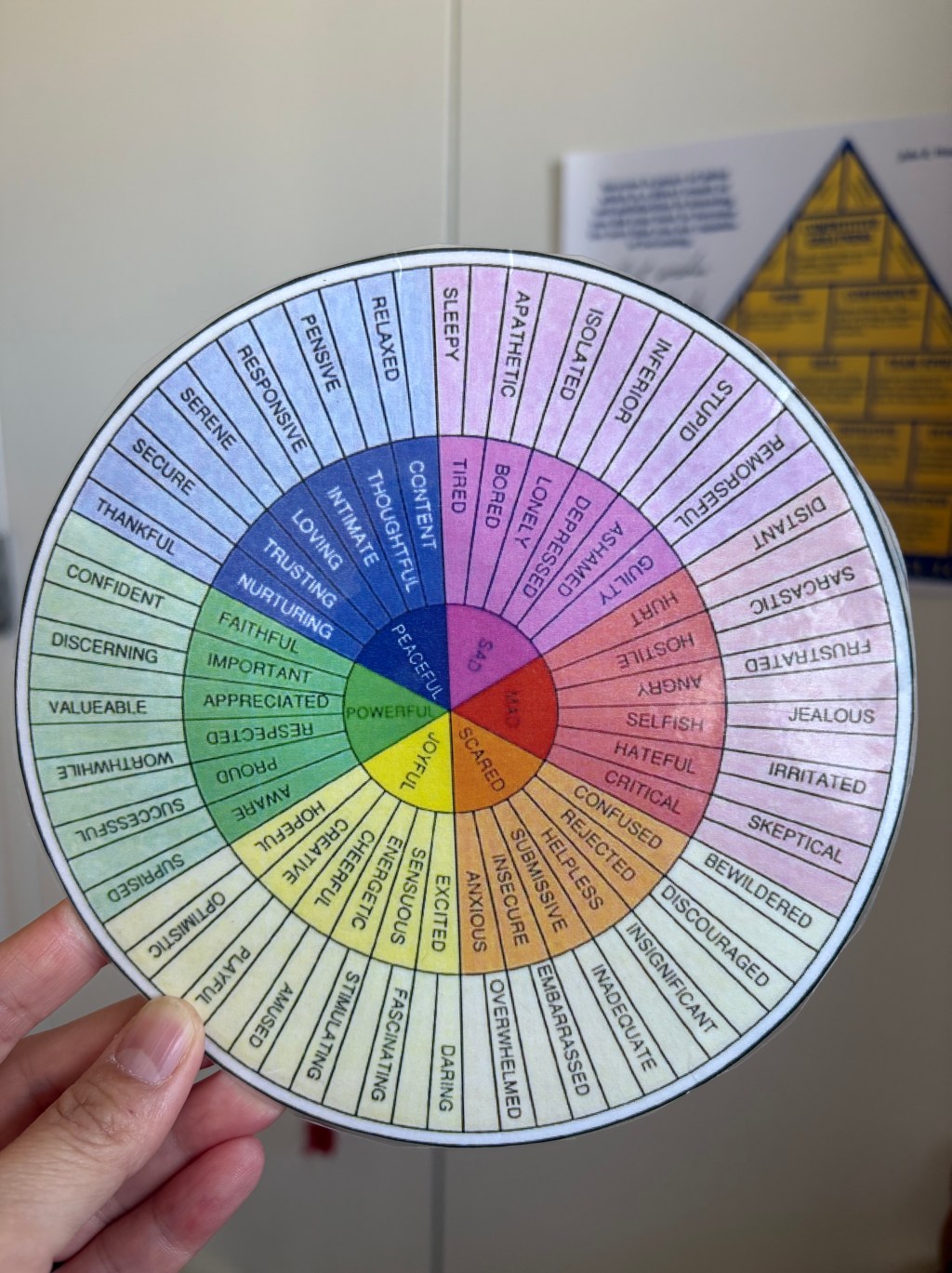
If you need help accessing more emotion words, I highly recommend using a Feelings Wheel. It’s a visual tool that organizes emotions into categories and subcategories, making it easier to find the right word. You can explore a free version in English here: https://feelingswheel.com/

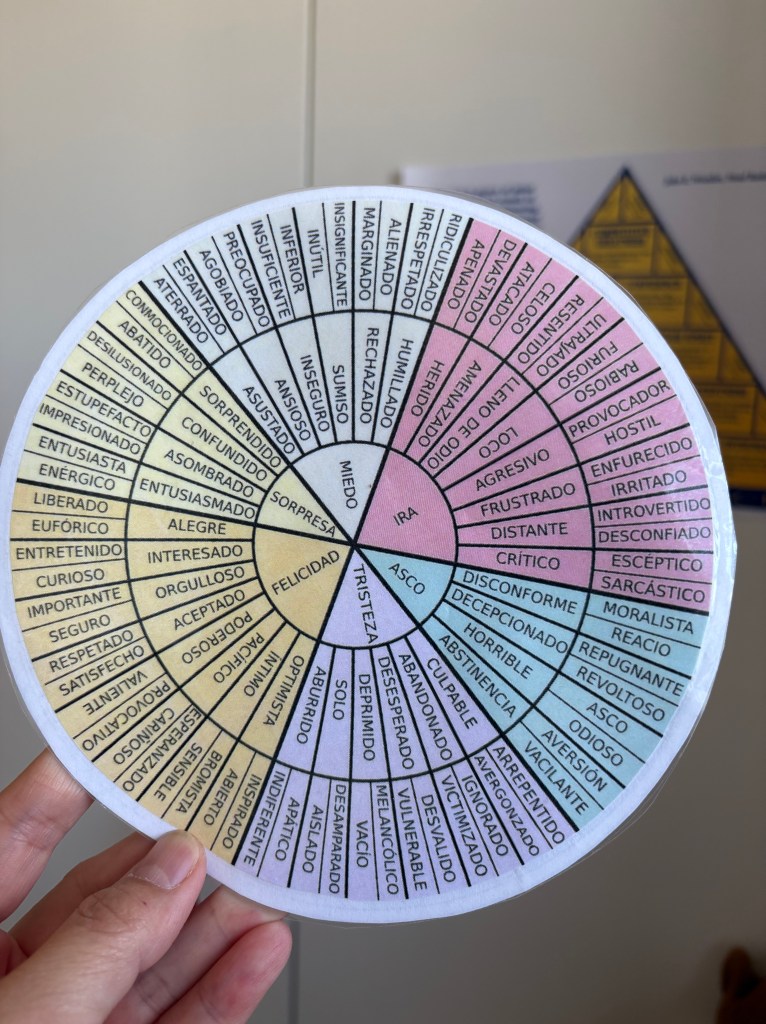
Two-sided feelings wheel version made via my old boss’ printer and a laminating machine, at my old clinic many years ago
Practical Tips for Athletes & Coaches
- Name It Out Loud (or on Paper)
Take 60 seconds to check in with yourself during the day. Ask: What am I feeling right now? Then put a name to it — tired, stressed, excited, overwhelmed. Even a one-word label can shift you from autopilot into awareness.- NOTE: For some, it may be easier to first identify a PHYSICAL sensation THEN tie it to an emotion word.
- For example: I feel butterflies in my stomach and my heart is beating hard. Using the Feelings Wheel, I notice feeling nervous in my stomach, and overwhelmed in my chest.
- Connect the Dots
Once you’ve named the emotion, ask: What’s fueling this? Is it lack of sleep, fear of failure, overcommitment, unresolved conflict? Understanding the “why” gives you a lever to change it. - Make a Micro-Adjustment
Don’t wait for a meltdown to act. If you notice you’re irritable from overtraining, swap one workout for active recovery. If you’re drained from constant team demands, block a single evening for yourself. - Practice Saying “No” Without Over-Explaining
A simple “I can’t take that on right now” is a skill worth mastering. Boundaries protect performance as much as nutrition and training plans do. - Model It for Others
This is especially important for coaches: Your athletes will mirror you. If they see you acknowledging your own limits and caring for yourself, they’re more likely to give themselves permission to do the same.
The Strongest Move You Can Make
Owning your feelings is not weakness — it’s leadership! It’s one of the most underused athlete burnout prevention strategies out there.
So the next time you feel that tightening in your chest, that pit in your stomach, or that edge in your voice, don’t push it away. Name it. Understand it. Then choose your next move with intention.
That’s not “woo-woo.” That’s winning smarter.
If you’d like support in learning how to name your emotions and turn them into tools for performance, resilience, and recovery, I’d be honored to work with you. You can reach me at info@lcollinslcsw.com or visit lcollinslcsw.com to learn more.
In solidarity,
Laura
Note: This and every Athlete Illuminated post is for educational purposes only and not a replacement for mental health treatment. If you are in urgent need of mental health support, please call 9-8-8. If you are experiencing an emergency, please call 9-1-1 or go to your nearest emergency room. For ongoing mental health concerns, consider seeking professional support or therapy.
 The Athlete Psychotherapist
Leave a comment