
My heart can deeply ache for high performance communities.
I can’t tell you the number of athletes, coaches, musicians, dancers, parents, guardians, and trainers that have shared the feeling that they are between a rock and a hard spot. But, the number is a lot.
They share that they are grappling with questions that often begin with these 5 words:
“What is the line between…?”
- being realistic versus tough versus abusive.
- being caring versus coddling.
- being too controlling versus not engaged enough.
- living vicariously through their child/athlete/musician/dancer versus simply supporting their child/athlete/musician/dancer.
If your question is about signs of abuse, let me redirect you to “Spot a Spider,” an amazing program by physician, former gymnast, and sur-thrivor, Amy Saltzman, M.D. You won’t find a better hub for information, videos, and resources that will educate and empower you with knowledge and understanding around abuse.
If your question is more of the “What can I do myself? Where can I start? How can I be more informed?” flair, stay here because…
This is where your “trauma-informed approach” journey begins.
The coaches, parents, and guardians that have spoken with me are not the “dictatorship” kind.
They may have grown up at a time when kids were “seen but not heard,” expected to act like adults when in reality they were simply developing child- and adolescent- minds and bodies.
As today’s adults, they absolutely want the best for the young people in their lives. They want young people to:
- Have fun.
- Make friends.
- Be resilient and yet, kind.
- Win both at their sport and in their personal lives.
But how we go about supporting them will be directly tied to the internal imprints made by our own lived-experiences.
We could go down a wormhole of talking about the incredible and varied experiences that have shaped how we show up for our high performers today (hence, why Joy Silva and I co-host the podcast, “Hahnacity” – healing through storytelling); however, for today, we’re focusing on trauma.
Substance Abuse and Mental Health Services Administration (SAMHSA) says, “Individual trauma results from an event, series of events, or a set of circumstances that an individual experiences as physically or emotionally harmful or life threatening and that may have lasting adverse effects on the individual’s functioning and mental, physical, social, emotional, or spiritual well-being.”(1)
There are various types of trauma. Trauma can be a one-time event, occur over and over again, and/or come from different sources.
Some examples of trauma: A car accident. Being put down and cursed at by “toughen-up coaching.” Bullied at school. Intimate partner violence.
It is totally normal for a person to have a response to a traumatic event(s). Responses could be physical, mental, emotional, and often a combination of these. And these responses can come and go over a person’s lifetime.
Some examples of responses to trauma could be: Self-isolation. Anxiety. Depression. Weight loss. Weight gain. Insomnia. Thoughts of hurting oneself.
And trauma…is widespread.
In the United States alone, 70% of adults have experienced trauma and it is the 4th leading cause of death for all ages. (2)
National SAFE KIDS Campaign and the American Academy of Pediatrics remind us that about “3.5 million youth (14 and younger) get hurt annually while playing sports or recreational activities.” (3)
And SafeSport identified key areas of harm that impacted athletes in 2024 (4):
- Anti-Inclusivity
- Discrimination
- Emotional Harm and Neglect
- Physical Harm
- Stalking
- Sexual Harm
Some will say, “Fine. So what? Everyone has trauma. Why should we care?”
That’s one way to look at it, I guess. For much of humankind’s history, “just deal with it,” “toughen up,” and “stop your crying” have been the response to all things trauma and emotions.
But then science showed us something different…cue the great pyramid of the Adverse Childhood Experiences Study (ACES) (5):
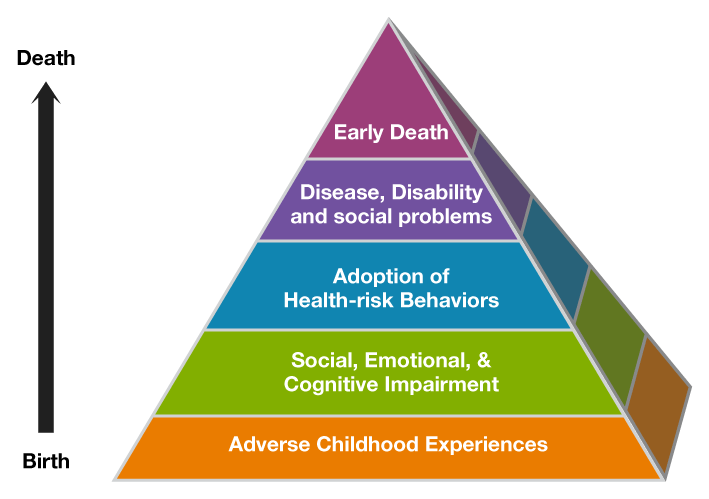
Basically, more traumatic experiences early on in a person’s life can lead to:
- a shorter lifespan,
- increased health problems (chronic diseases: diabetes, hypertension, etc.),
- increased mental health issues (depression, anxiety, alcohol and substance use, etc.),
- decreased workforce,
- increased conflict within families and communities, and
- increased costs on systems: healthcare, education, benefits.
Remember how many U.S. adults are living with at least one traumatic event? That’s right…70%.
That’s a lot of people. That may include ourselves. That can include the people we love. Maybe someone you know is coming to mind as you read about the impact of trauma and ACES. Maybe you’re reflecting on your experiences. Maybe you or someone you know is already experiencing mental health and/or physical issues because of trauma.
You’re not alone. Not by a long shot. And the impact of all of this shows up in our workplaces, schools, religious institutions…heck, just walking down the street.

Seems pretty obvious to me that the old “deal with it” way of being isn’t working.
So…
What is “trauma-informed care” and what exactly does it mean for sports or other high performance disciplines?
“Trauma-informed care” came on the scene in the 1970s, when Vietnam War veterans returned home. Medicine took into consideration their physical, mental, and emotional pain and injuries – from which was born “the diagnosis of Post-Traumatic Stress Disorder (PTSD), and a burgeoning awareness that trauma, especially multiple traumas, can affect the way in which the brain, the nervous system, and the body function or malfunction.” (6)
Since then, ongoing trauma research has found that trauma impacts the mind and body in so many ways. From acute responses, like shock, to chronic responses, like heart disease.
Today, trauma-informed care is not only a healthcare practice, but a movement.
“Trauma-informed care is a strengths-based framework that is grounded in an understanding of and responsiveness to the impact of trauma, that emphasizes physical, psychological, and emotional safety for both providers and survivors, and that creates opportunities for survivors to rebuild a sense of control and empowerment.” – Hopper, Bassuk, and Olivet, 2010 (7)
And applying this to sports and other high performance disciplines…
The trauma-informed approach is about (8):
- Trauma Awareness: Be aware of how trauma impacts people, recognize basic signs, and try one’s best to NOT cause or re-traumatize others.
- Safety: Ensuring an optimal environment of physical, mental, and emotional respect, trust, and security.
- Choice & Empowerment: A relationship of options and support, not dictatorship. Each person has agency to make the best choice for oneself.
- Strengths-Based: Seeing and building upon the strengths of each individual, not dictatorship.
- For ALL members of the community, including yourself.
This is not coddling. This IS empathy being more aware of others experiences as well as your own, and responding with the goal of at least trying NOT to re-traumatize yourself or them.
This is not being controlling or coercive. This is healthy boundaries, collaboration, and respect, building a sense of community through relationship.
This is not being weak. This is seeing the talent as a whole person first, being realistic, understanding, and strengths-focused.
The benefits are immense, but just to name a few:
- Healthier whole people
- More productivity
- Increased community
- Increased trust and collaboration
- Decreased stress
If this sounds like something you would like for yourself, your team, your organization, please do not hesitate to reach out.
If you are feeling overwhelmed by all of this information, unsure of where to start…it’s understandable.
What I like to tell people is this: Ask yourself the “What-for” question.
The next time you feel riled up by:
- an athlete not performing the way you want,
- an athlete not responding to you in the way you want,
- an athlete – who has a lot of promise and potential – does not want to compete in that upcoming competition,
It’s worth asking yourself, “What am I getting all riled up for?” What part is really about the athlete? What part is about my own past, my own personal stuff?
If the answer is leaning on the “my own past and personal stuff” side, it is okay to take a breath, then refocus on the athlete. Listen-in and collaborate – START WHERE THE ATHLETE IS AT.
And when it is safe for you to attend to your own personal stuff, start your own journey into self-awareness and care. Talk to trusted loved ones. Develop and lean into your own community. If you need, see a psychotherapist to explore and understand the roots of your reactions.
As the saying goes, “Your past is not your fault, but your present and future are your responsibility.” If you can gain peace and understanding of yourself, you can certainly do so for anyone else.
Feel free to direct message me if you have any questions and/or feel interested in taking the next step for yourself, your team, and/or your program/organization.
I wish you all the best,
Laura
(1) SAMHSA, Practical Guide for Implementing a Trauma-Informed Approach: https://library.samhsa.gov/sites/default/files/pep23-06-05-005.pdf
(2) National Council for Behavioral Health, Trauma Infographic, (2022)
(3) National Safety Council, Sports and Recreational Injuries, (2023)
(4) SafeSport, 2024 Culture and Climate Report, (2024)
(5) Felitti, Anda, Nordenberg, Williamson, Spitz, Edwards, Koss, and Marks, “Relationship of Childhood Abuse and Household Dysfunction to Many of the Leading Causes of Death in Adults, The Adverse Childhood Experiences (ACE) Study,” American Journal of Preventitive Medicine, Vol. 14, Issue 4, p. 245-258, May 1998: https://www.ajpmonline.org/article/S0749-3797(98)00017-8/fulltext#FIG2
(6) Ohio Leadership Advisory Council, “History of Trauma-Informed Care and Education”
(7) Trauma Informed Oregon, “What is Trauma Informed Care?” – www.traumainformedoregon.org
(8) The Conversation (2023), “Why taking a trauma- and violence-informed approach can ake sport safer and more equitable”
The National Child Traumatic Stress Network, Trauma Types
Note: This and every Athlete Illuminated post is for educational purposes only and not a replacement for mental health treatment. If you are in urgent need of mental health support, please call 9-8-8. If you are experiencing an emergency, please call 9-1-1 or go to your nearest emergency room. For ongoing mental health concerns, consider seeking professional support or therapy.
 The Athlete Psychotherapist
Leave a comment